
If you're a plumber, electrician, HVAC contractor, or roofer, you've probably done the "right" thing already. You claimed your Google Business Profile, filled in your hours, added a logo, and moved on. Then, a few months later, the phone got quiet. Newer competitors, some with worse reviews and less experience than you, started showing up above you in the map pack.
This isn't bad luck, and it isn't Google punishing you. It's what happens when a Google Business Profile (GBP) sits untouched while competitors' profiles stay active. Google's local algorithm increasingly rewards businesses that show ongoing signs of life: recent reviews, fresh photos, current service information, and regular activity. Profiles that were set up once and never revisited fall behind. For trades businesses, where most new customers start their search with "plumber near me" or "electrician open now," that difference shows up directly in how many calls you get.
This guide breaks down what "active" actually means to Google in 2026, what the data says really moves your Google Maps ranking, and the specific GBP activities worth your time versus the ones that are mostly noise. If you're searching for practical local SEO for contractors, not theory, but a plan you can run this week, this is built for you.
Why "Set and Forget" Google Business Profiles Lose Calls to Competitors
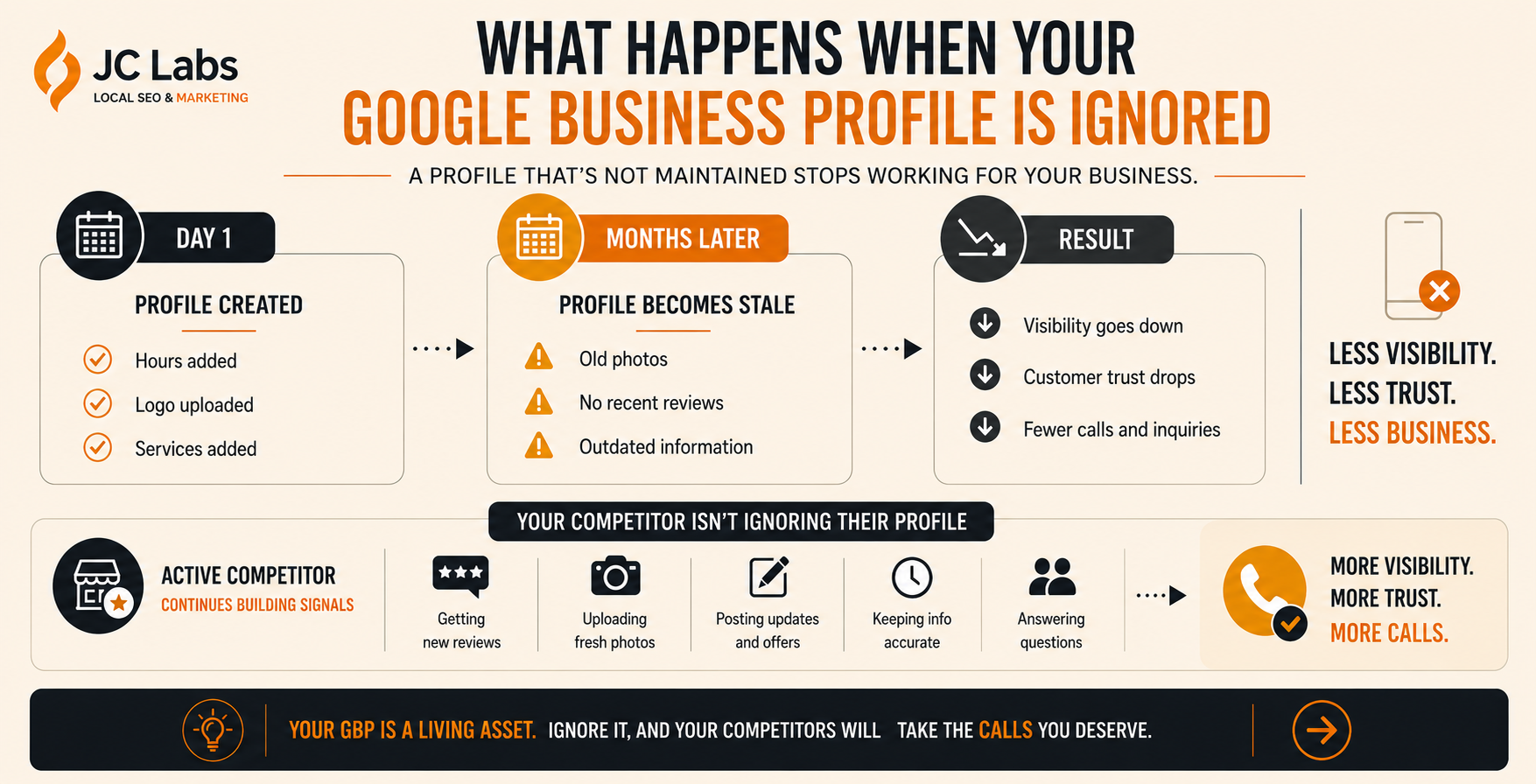
A Google Business Profile isn't a static listing like a phone book entry. It's closer to a live feed that Google re-evaluates constantly. Every time someone searches "roofer near me" or "AC repair [city]," Google's algorithm scans dozens of signals on your profile and your competitors' profiles to decide who appears in the local 3-pack and who gets buried on page two of Maps.
Two things happen when a profile goes stale. Google has less recent data to confirm the business is still operating normally at the listed hours, address, and service area, which matters directly to ranking. And customers browsing your profile see outdated photos, no recent reviews, and no posts, so even if you do show up, fewer people call, because the profile doesn't build trust in the moment they're deciding who to contact.
That second part matters as much as ranking position. A business ranked #3 with an active, trustworthy profile often gets more calls than a business ranked #1 with a thin one. Visibility and conversion are two different problems, and an active GBP strategy solves both.
What Actually Moves Your Google Maps Ranking
It's worth being precise here, because a lot of local SEO advice overstates what drives rankings versus what drives calls. According to Whitespark's 2026 Local Search Ranking Factors study, the largest ongoing survey of local SEO practitioners, the strongest local pack ranking signals are:
Primary GBP category selection is the single highest-weighted factor in the entire study. If your primary category is "Plumber" but most of your leads come from drain cleaning, and you've buried that under a secondary category, you're leaving ranking strength on the table.
Proximity to the searcher and keyword relevance in your business title come next, followed by business hours accuracy. Google visibly deprioritizes listings that appear closed at the time of a search, which is a common and easily fixed issue for trades businesses with irregular hours or after-hours emergency service.
Review signals as a group scored highest of any factor category for 2026: the quantity of reviews with written text, the recency of those reviews (a steady trickle beats a burst of 20 reviews once a year), and your average star rating all carry real ranking weight. Profile completeness, meaning filled-out services, attributes, and business description, also ranks solidly in the top 20 factors.
Where the data gets more nuanced is Google Posts, photo uploads, and Q&A activity. BrightLocal's analysis of the same survey found that posting frequency and photo quantity have minimal direct effect on local pack position. If your goal were purely "rank #1," you'd focus almost entirely on category accuracy, reviews, and completeness.
But ranking isn't the goal. Calls are. And that's where an active profile earns its keep.
Why GBP Activity Still Matters, Even When It's Not the Top Ranking Signal
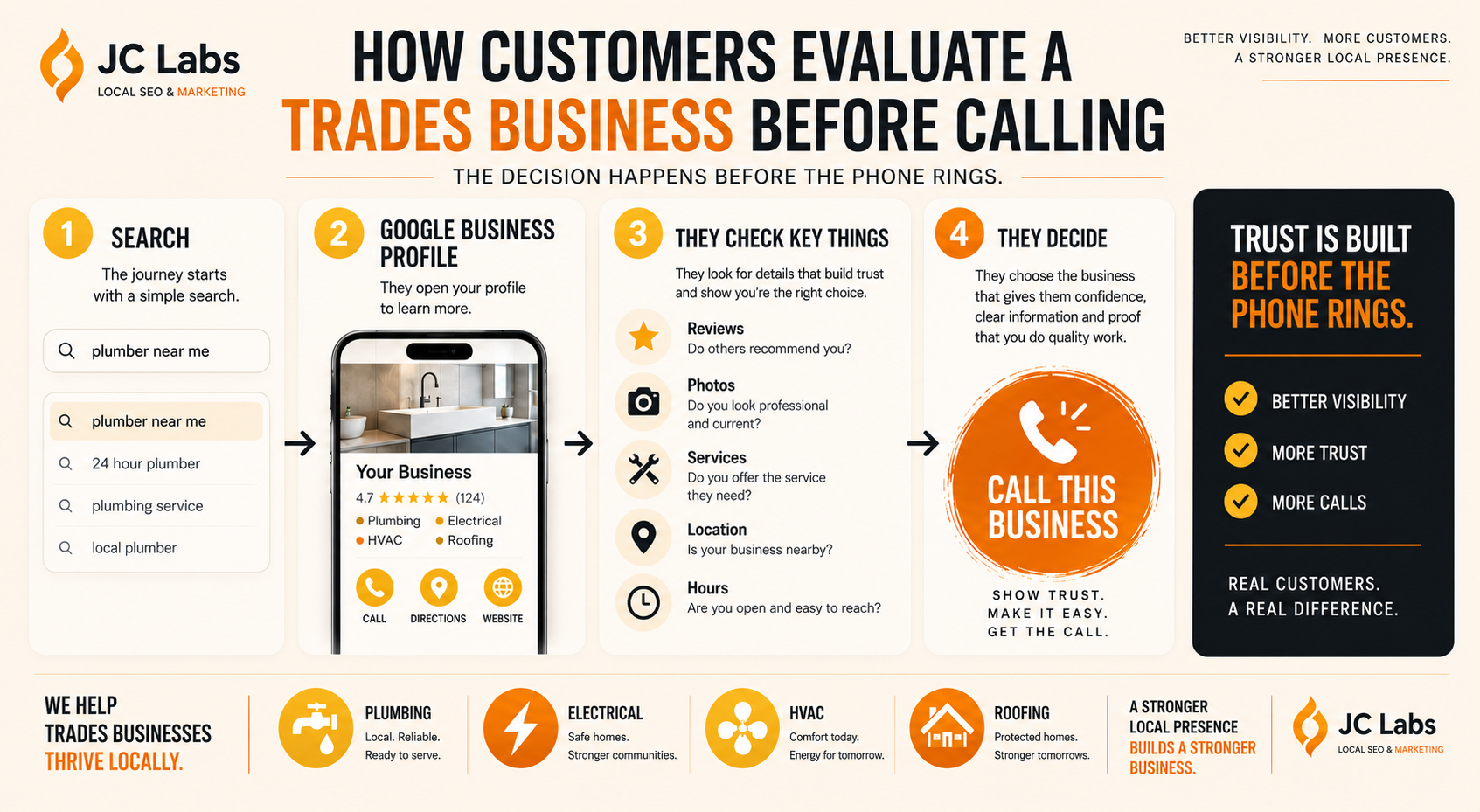
This is the part most local SEO advice skips: even when posts and photos don't move your position in the map pack, they change what happens after someone finds you. For a trades business, that's the number that actually pays the bills.
Photos drive calls even when they don't drive rank
Profiles with 100+ photos generate 520% more phone calls and 1,065% more website clicks than photo-thin profiles, and 2,717% more requests for directions. Listings ranking in the top 3 spots average around 250 photos, compared to roughly 200 photos for positions four through ten. So even among competitors who are already ranking well, the ones with more visual proof of their work are converting better.
For a plumber or electrician, this is a straightforward opportunity most competitors ignore: photograph the actual job. A clean, labeled electrical panel upgrade. A tidy trenchless pipe repair. A technician's truck parked outside a real customer's house. This isn't stock photography. It's evidence that you show up and do quality work, and it's what a homeowner scrolls through in the ten seconds before deciding who to call.
Posts build engagement and long-term ranking momentum
Businesses that publish Google Business Profile posts consistently, even at a modest bi-monthly cadence, see roughly 13% higher branded engagement and 12% more branded search impressions. More notably, businesses that maintained a weekly posting habit saw an average local pack position improvement of 2.3 spots over six months. That's not a direct ranking algorithm bonus for the post itself. It's the compounding effect of a profile that keeps generating fresh content, clicks, and engagement signals that Google's system reads as "this business is active and relevant."
For an HVAC company, a useful post isn't a generic "Happy to serve you!" It's timed and specific: "AC not keeping up in this heat? We have same-day appointments open this week," published the day before a heat wave, or "Now booking furnace tune-ups before the first cold snap" in early fall.
Review responses are a revenue lever, not just good manners
Businesses that respond to all their reviews, good and bad, see about 18% more revenue and roughly 50% better conversion rates than businesses that don't respond at all. This is one of the highest-leverage activities on this entire list, and it takes minutes per review.
A roofer responding to a middling 3-star review with a specific, professional explanation of what happened and how it was resolved does more to win the next customer's trust than the review itself ever could. Prospective customers read responses, not just star ratings.
AI Overviews are now pulling directly from active profiles
Roughly 40% of local searches now surface Google's AI Overviews, which pull summarized information from Business Profile data, including recent posts, Q&A, services, and reviews, to answer questions like "who's the best-rated plumber near me that does emergency calls." A profile with current, detailed information has a real shot at being the source AI Overviews quote. A profile that hasn't been touched in eight months doesn't.
Practical Examples: What Active GBP Management Looks Like for Trades Businesses
Plumber: After a cold snap causes a spike in burst-pipe calls, post same-week: "Seeing a lot of frozen pipe calls this week. Here's what to do before we arrive," paired with a photo from an actual job. Respond to every review from that week within 48 hours, since call volume during weather events is when the most new customers are actively comparing options.
Electrician: Add a dedicated "EV Charger Installation" service listing with a keyword-rich description rather than folding it into a general "electrical work" line. Photograph three recent EV charger or panel upgrade jobs and upload them the same week, since Google now weighs custom service titles and descriptions more heavily than in past years.
HVAC company: Build a light seasonal posting cadence: spring AC tune-up reminders, summer emergency capacity updates, fall furnace inspection offers, winter emergency heat repair availability. This keeps the profile active year-round instead of only during peak season, which is when most HVAC profiles go quiet and lose ranking momentum.
Roofer: After a hailstorm or major wind event, post an update the same day: current inspection availability and what homeowners should photograph for insurance purposes. Follow up with before/after photos of completed storm repairs as jobs wrap up. This is exactly the kind of timely, specific content that outperforms generic posts in both engagement and trust.
The Google Business Profile Activity Checklist
Use this as a running maintenance schedule, not a one-time setup task. Consistency is what the algorithm and your customers are both actually responding to. This is the core routine to improve Google Business Profile visibility and get more calls from your Google Business Profile month over month.
Weekly:
- Respond to every new review within 24 to 48 hours, including negative ones
- Upload 3 to 5 new photos of completed jobs, trucks, or crew (not stock images)
- Publish at least one Google Post tied to a real, current offer or job
- Check and answer any new questions in the Q&A section
Monthly:
- Audit business hours for accuracy, including holidays and seasonal changes
- Confirm NAP (name, address, phone) consistency across your website and directories
- Review and update your services list with current offerings and keyword-rich descriptions
- Check for and remove any duplicate or unauthorized "suggested edits" to your profile
Quarterly:
- Refresh your photo gallery with seasonally relevant work
- Update your service area if your coverage has changed
- Run a review-request campaign to keep review recency steady rather than sporadic
- Spot-check two or three top local competitors' profiles for gaps you can close
How The JC Labs Fixes This Exact Problem
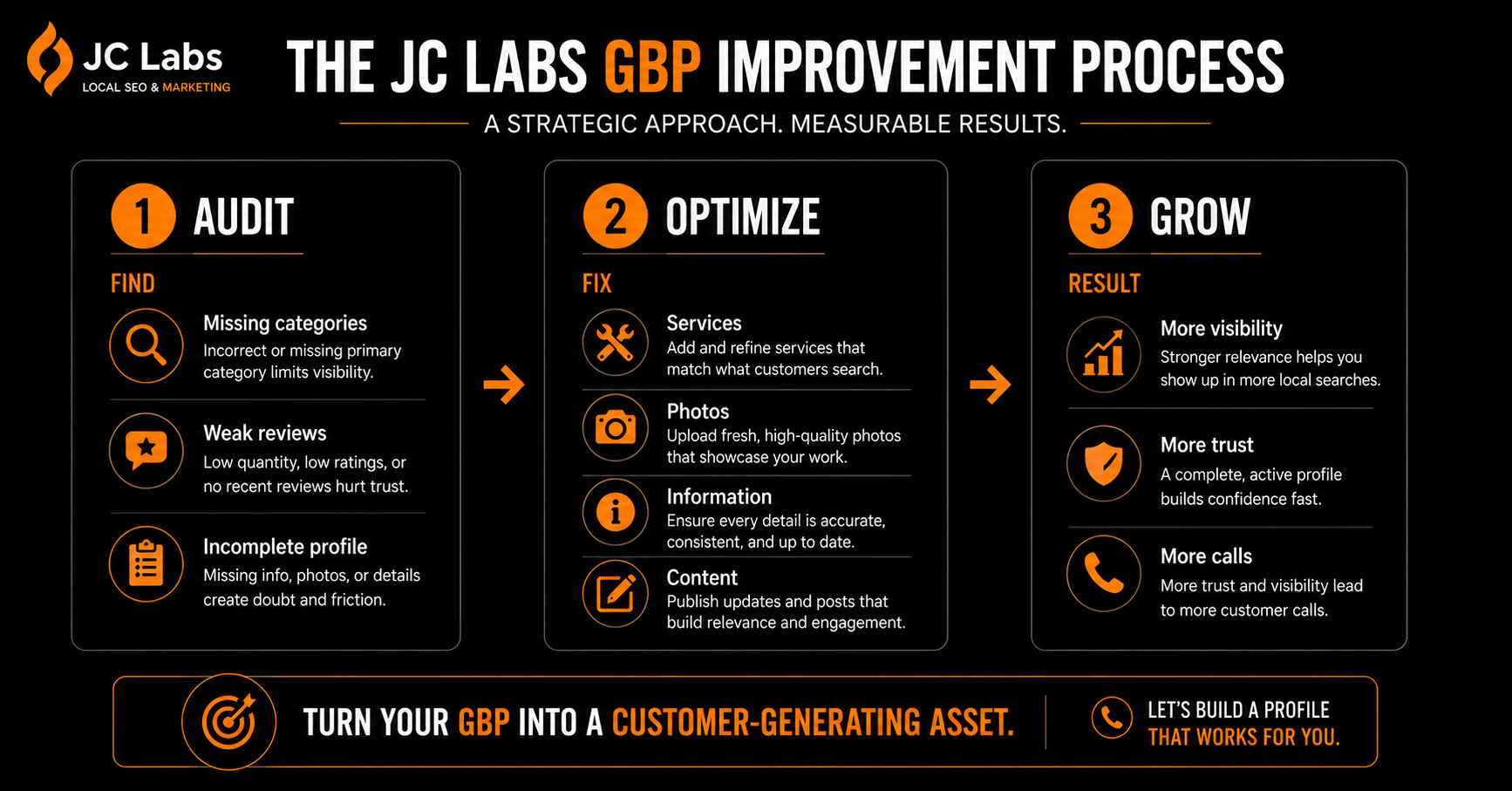
This is what we do all day for businesses like yours. If you set up your Google Business Profile once, haven't touched it in months, and have watched calls slow down while less-established competitors climb the map pack, that's the gap we close. We run a full GBP audit that shows exactly which factors are costing you calls (category accuracy, review velocity, photo coverage, service listings, and how you compare against local competitors), then we fix what the audit finds.
- GBP audits: we check your category, completeness, and review signals against what's actually driving rankings in your market right now.
- Google Business Profile management: we handle the weekly cadence, posting timed job-specific updates, uploading real work photos, and responding to every review within 48 hours.
- Local SEO for contractors: we correct primary and secondary category selection, build keyword-rich service listings, and fix NAP consistency issues across directories.
- Lead gen strategy: we make sure the visibility turns into booked jobs, not just profile views.
Most trades businesses treat their Google Business Profile like a listing they filled out once. We treat it like the storefront it actually is, one that needs to stay stocked, current, and staffed.
Your competitors are not winning more calls because they work harder or charge less. They're winning because their Google Business Profile shows up active every time someone searches, and yours doesn't. That's fixable, and it doesn't take a rebrand or a new website. Book a free GBP audit and see exactly which signals are costing you calls this month. Head to and tell us your trade and service area. The audit is free. The calls you keep losing are not.
Frequently asked questions
What is an active Google Business Profile?
A profile you update regularly with posts, fresh photos, service changes and review responses, instead of one you set and forget.
Does profile activity actually help ranking?
Google favors active, accurate profiles, and customers trust them more. Consistent activity plus reviews is one of the strongest local signals.
How often should I update my profile?
Post once or twice a week, add photos monthly, and respond to reviews within a day or two. We handle this as part of GBP management.