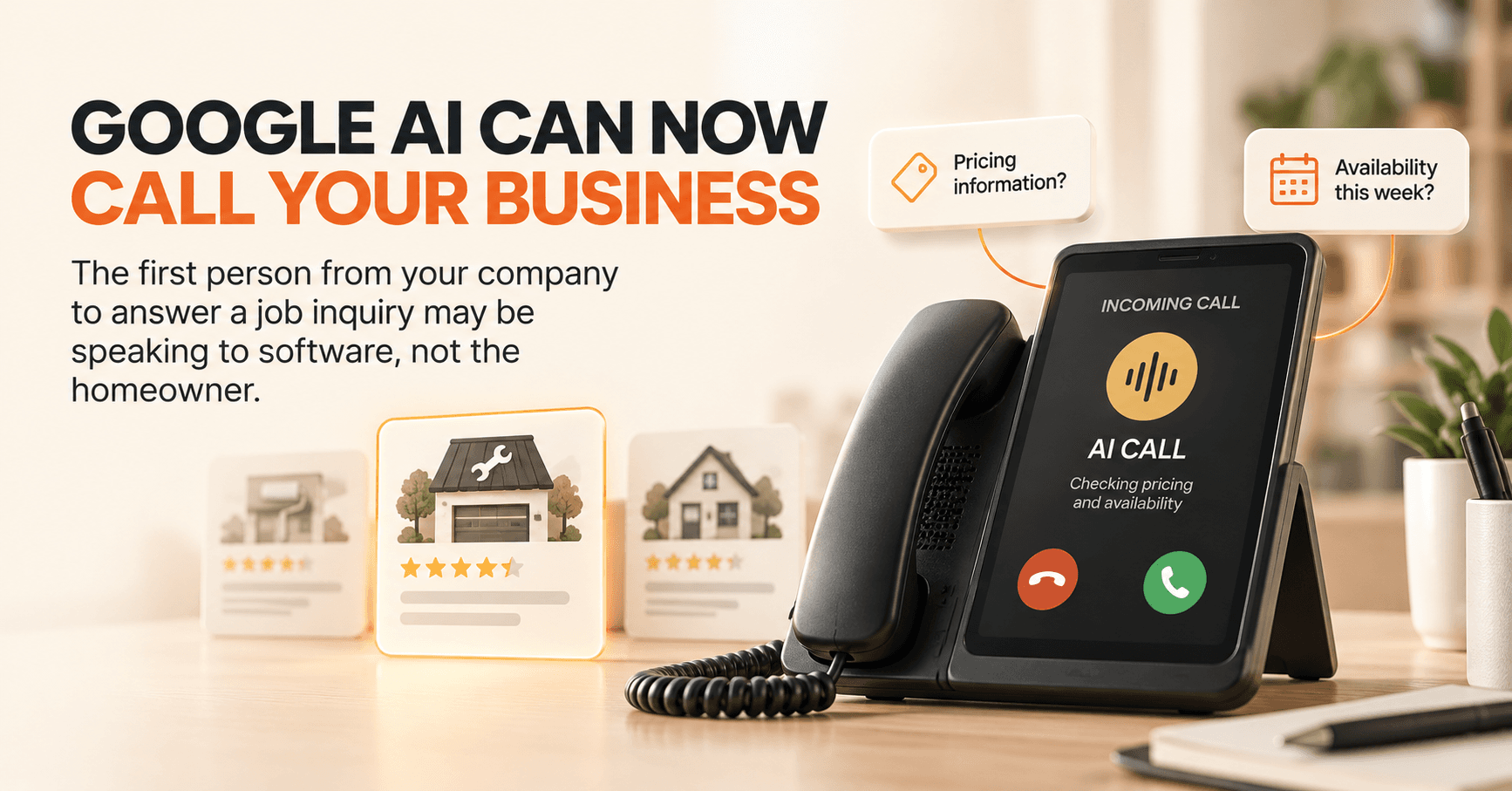
Google can now call local businesses on a customer's behalf, ask about pricing and availability, and hand that customer a summary of everyone it reached. The first person from your company to talk about a job may be speaking to software, not the homeowner.
That changes the front end of local lead generation. Instead of a customer calling five shops, Google calls them. The business still has to win the work, but now it first has to survive a short, unannounced interview.
Here is what shipped, why it matters, and the practical steps that keep your business in the comparison.
What Google actually shipped
The feature showed up first as an experiment called Ask for Me, aimed at narrow categories such as nail salons and auto repair. It then widened to US users in Search, where the option reads something like "Have AI check pricing." Google's own help documentation calls the broader idea agentic calling.
The flow is simple. A customer searches for a local service, taps the option to let AI check pricing, describes what they need, and Google calls several nearby businesses. The answers come back to the customer as a comparison. Google identifies itself on the call, and the calls are monitored and recorded.
At Google I/O in May 2026, Google expanded the categories to include home repair, beauty, and pet care. That is the part trades and service businesses should pay attention to, because home repair covers plumbing, HVAC, electrical, appliance repair, roofing, and most of the work that keeps a service company busy.
Three details matter most:
- Google selects businesses from your normal local search rankings. If you do not rank, you do not get called.
- The process does not create a booking. The customer still contacts the provider they choose.
- You can opt out. The setting lives in your Business Profile advanced settings, and availability is limited to the US in most states.
Why this matters for your leads
Most owners hear "AI" and assume it is someone else's problem. This one shows up on your phone.
Only ranking businesses get the call
Google says it picks nearby providers using standard local search signals and how well the business matches the request. Your map pack position now decides whether you get invited to the comparison at all.
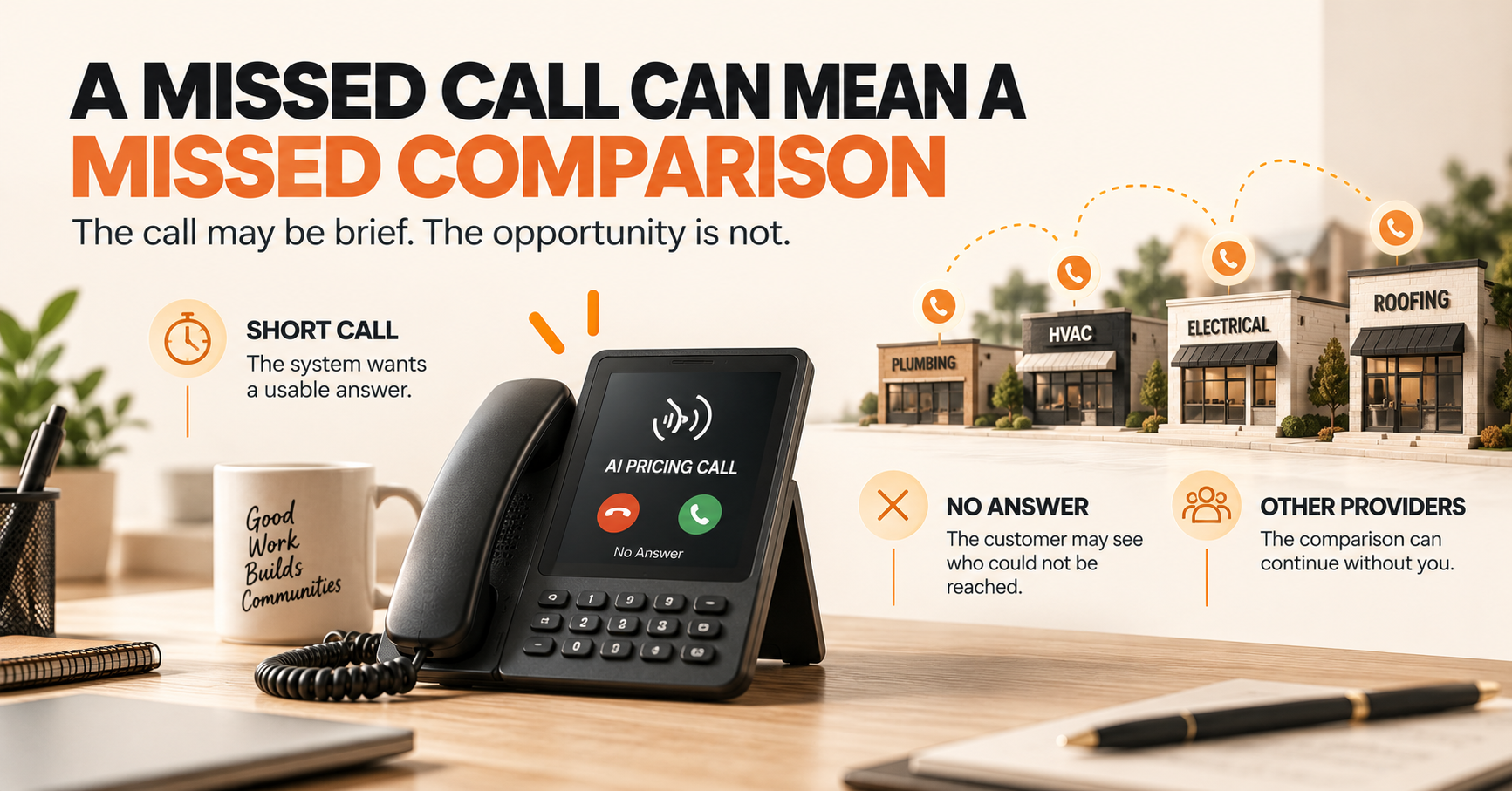
A missed call is a lost comparison
If nobody answers, the customer may see recommendations from other businesses, or a note about who could not be reached. The job does not come back later. It goes to whoever answered.
The call is short
These calls are businesslike and brief. The system wants a usable answer, not your company history. You are not closing the job on this call. You are earning a place in the customer's next decision.
What the call needs to hear
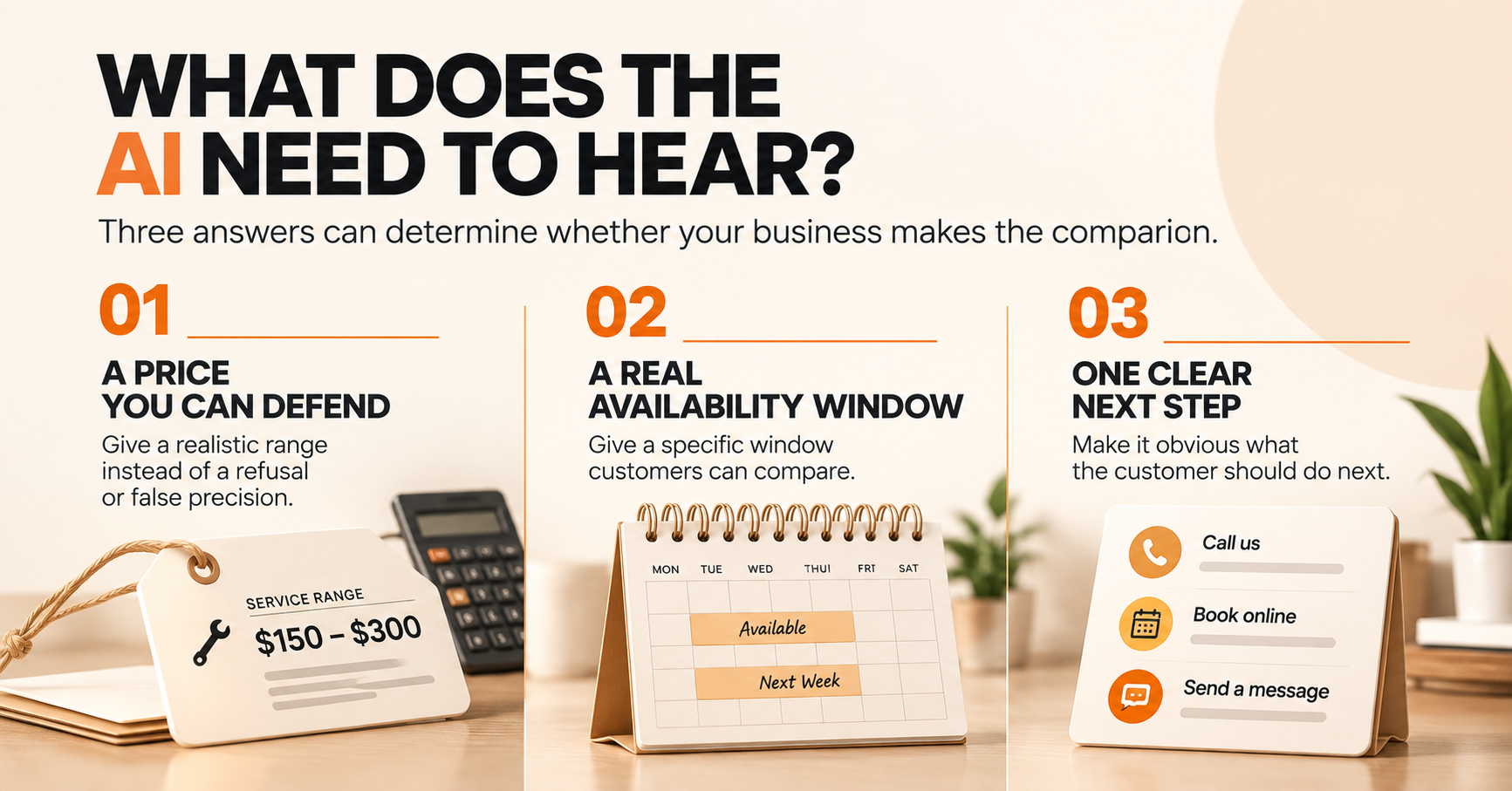
Strip it down and there are three things worth getting right.
A price you can defend
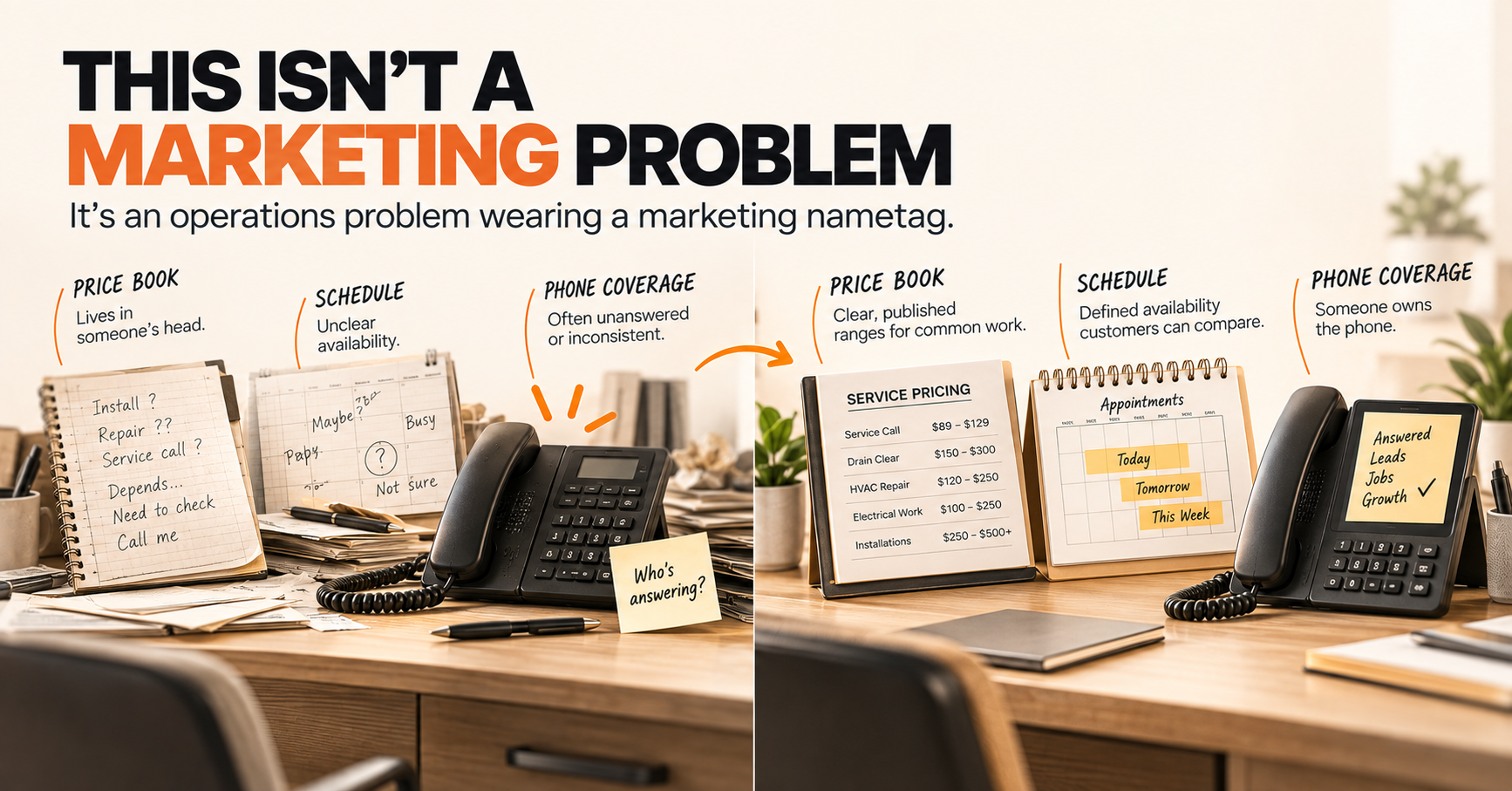
A range beats a refusal, and it beats fake precision. "Most standard drain clears run $150 to $300 depending on access" gives the system something real. So does "our diagnostic visit is $89 and repair pricing depends on what we find."
A real availability window
"Next-day appointments" is useful. "We can probably get there pretty soon" is not comparable to anything. Give a window a customer can weigh against your competitors.
One clear next step
One phone number, one booking page, one instruction. Save the qualifying questions for the human conversation, because there may be no human on the other end to answer them.
The gap most businesses have
Here is the honest diagnosis. This is not a writing problem, it is an operations problem wearing a marketing nametag.
In a lot of service businesses, the price book lives in the owner's head. Standard work has no published range. Calls ring to whoever is not elbow deep in a job, or into a phone tree built years ago. Nobody owns the phone during business hours, and nobody has written down what to say when someone asks what a job costs.
Nothing in that is a moral failing. It is just unmanaged. And it now has a measurable cost, because the first contact for a hot local lead may be a thirty second pricing question.
What JC Labs automates for this
We build the missing layer around your local SEO and phone process so AI calls do not quietly send work to a competitor.
It starts with a verified fact sheet per location: services, service areas, regular and holiday hours, and the ranges you are willing to publish for common work. That document keeps your profile, your site, and your phone answers saying the same thing.
From there we wire the operational pieces:
- A one page answer card for whoever picks up, covering the price range, the availability window, and the next step
- Phone coverage rules so calls are answered during business hours instead of ringing out
- Call logging that separates AI pricing calls from real leads, so you can see both without double counting
- An alert when an automated call goes unanswered, so the gap gets fixed the same week
- A monthly check that your ranking and profile data still match, since ranking decides who Google calls first
It works alongside the rest of our listing work, so the facts Google reads and the facts your team speaks come from one source.
FAQ
What is Google's AI calling feature?
It is an agentic feature in Google Search where a customer can ask Google to contact local businesses on their behalf to check pricing and availability. Google then calls several providers and emails the customer a summary. Google identifies itself, and the calls are recorded.
Can I turn these calls off?
Yes. The option to allow or reject automated calls and texts from Google sits in your Business Profile advanced settings. Turning it off makes your business invisible in a comparison your competitors still appear in, so it is worth a deliberate decision rather than a default.
Do these calls count as leads?
Not yet. Google says the process does not create a booking, and the customer contacts the chosen provider afterward. The call is an opportunity to be shortlisted, not a booked job, which is exactly why measurement and follow up matter.
Which businesses does Google call?
Google selects providers from local search results based on how well they match the request and how they rank nearby. Availability also varies by category and location. Strong local visibility is what puts you on the call list.
The bottom line
Google has added a step in front of the phone call you used to own. A customer can now let an AI screen several local businesses before anyone speaks to a human.
The fix is not exotic. Publish defensible price ranges, answer the phone, give a real availability window, and keep your local ranking and profile data accurate, because that is what decides who gets called first.
If your phone process is still living in one person's head, that is the first thing to write down.