
To write a useful Google review reply, acknowledge the customer's actual point, add one relevant detail you can verify, and give an appropriate next step. Keep private job information out of the public response. Before posting, check that every promise is something your business has approved and can deliver.
For a local trades business, the audience includes the homeowner deciding who to call next. A response that sounds attentive and reasonable can help that person assess your service. A copied thank-you or a defensive argument gives them less useful information.
This guide explains how to respond to Google reviews using a reusable reply brief, original examples and a small approval routine. The goal is consistent judgement without identical wording.
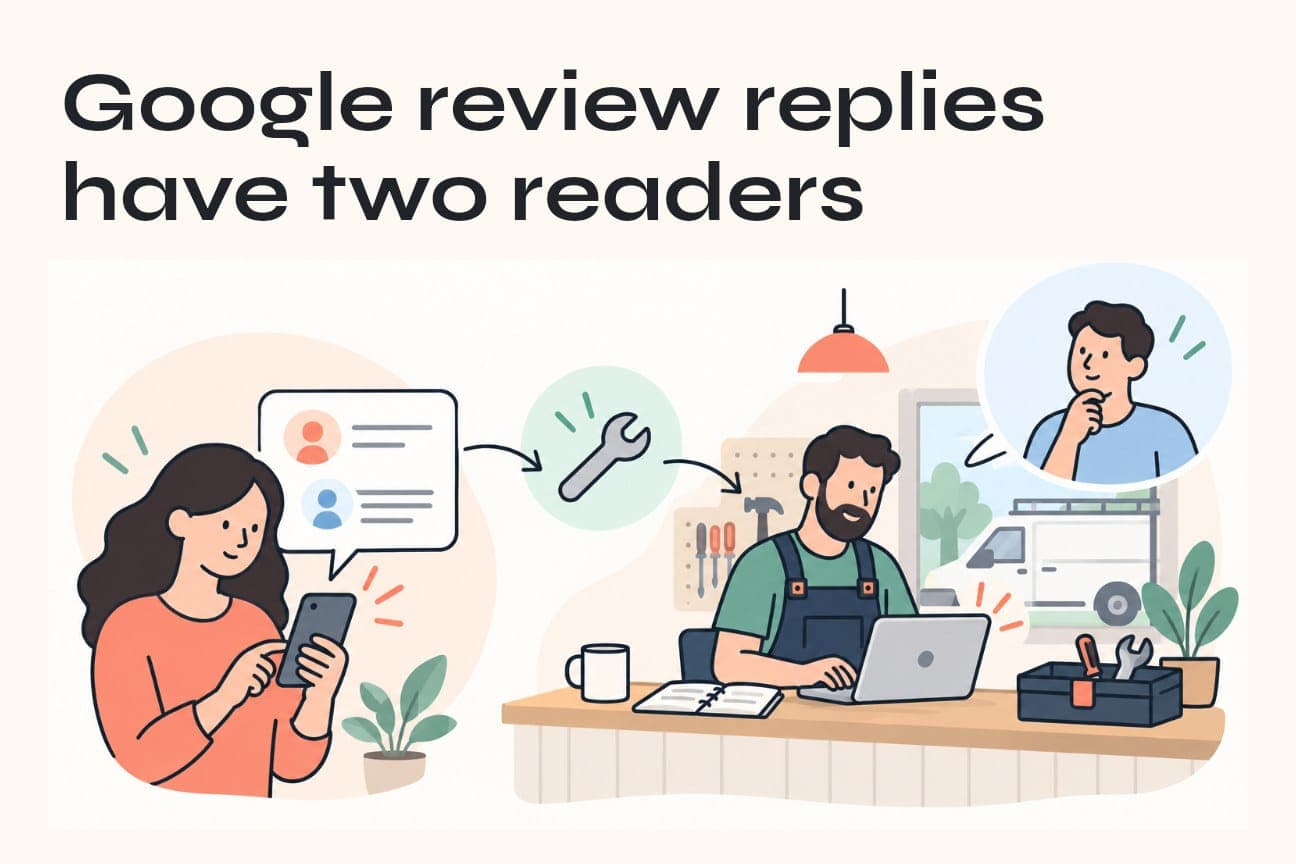
Why your review reply has two readers
Imagine a homeowner comparing two plumbers after a leak. Both have positive reviews. One replies to every customer with the same sentence. The other acknowledges the detail each person mentioned, such as a clear explanation or a tidy work area.
The second business gives the homeowner something concrete to evaluate. That does not establish a ranking advantage or guarantee a booking. It makes the visible conversation more useful.
Google's current reply guidance recommends concise, relevant responses and keeping complicated concerns private. A review reply is also a public statement by your business, so it deserves the same fact check as a service-page claim.
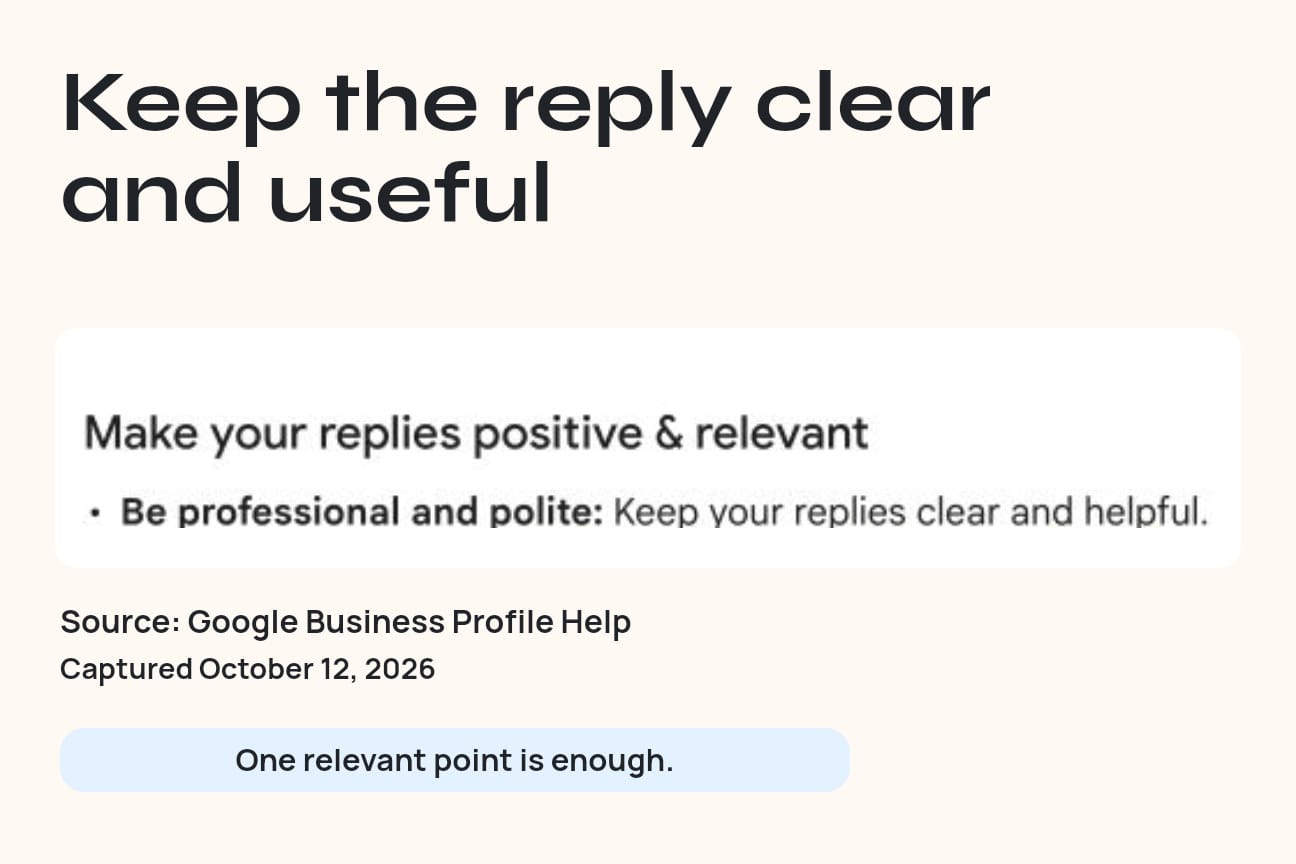
Use two questions before writing:
- What does this customer need acknowledged or answered?
- What could a future customer reasonably learn from our response?
If the answer is only “we need to look active,” pause. A short, specific response usually serves the reader better than a paragraph of promotion.
Build a reply brief before writing
Standardise the information you check, rather than the sentence you post. A reply brief gives whoever handles reviews enough context to respond accurately. It also tells a drafting tool which information it must leave out.
For a small business, a private note or shared document is sufficient. Start with these six fields:
| Brief field | What to record | Why it matters |
|---|---|---|
| Customer's main point | The service detail, question or concern in the review | Keeps the reply relevant |
| Checked facts | Only facts confirmed by someone responsible for the job | Prevents guesses becoming public claims |
| Safe public detail | One useful detail the customer already raised or approved | Makes the response specific without exposing records |
| Private information | Details that must stay inside the business | Gives the writer a clear exclusion list |
| Approved next step | A realistic action and who can carry it out | Prevents unauthorised promises |
| Contact route and approver | The official business channel and person checking the response | Gives the customer a workable way forward |
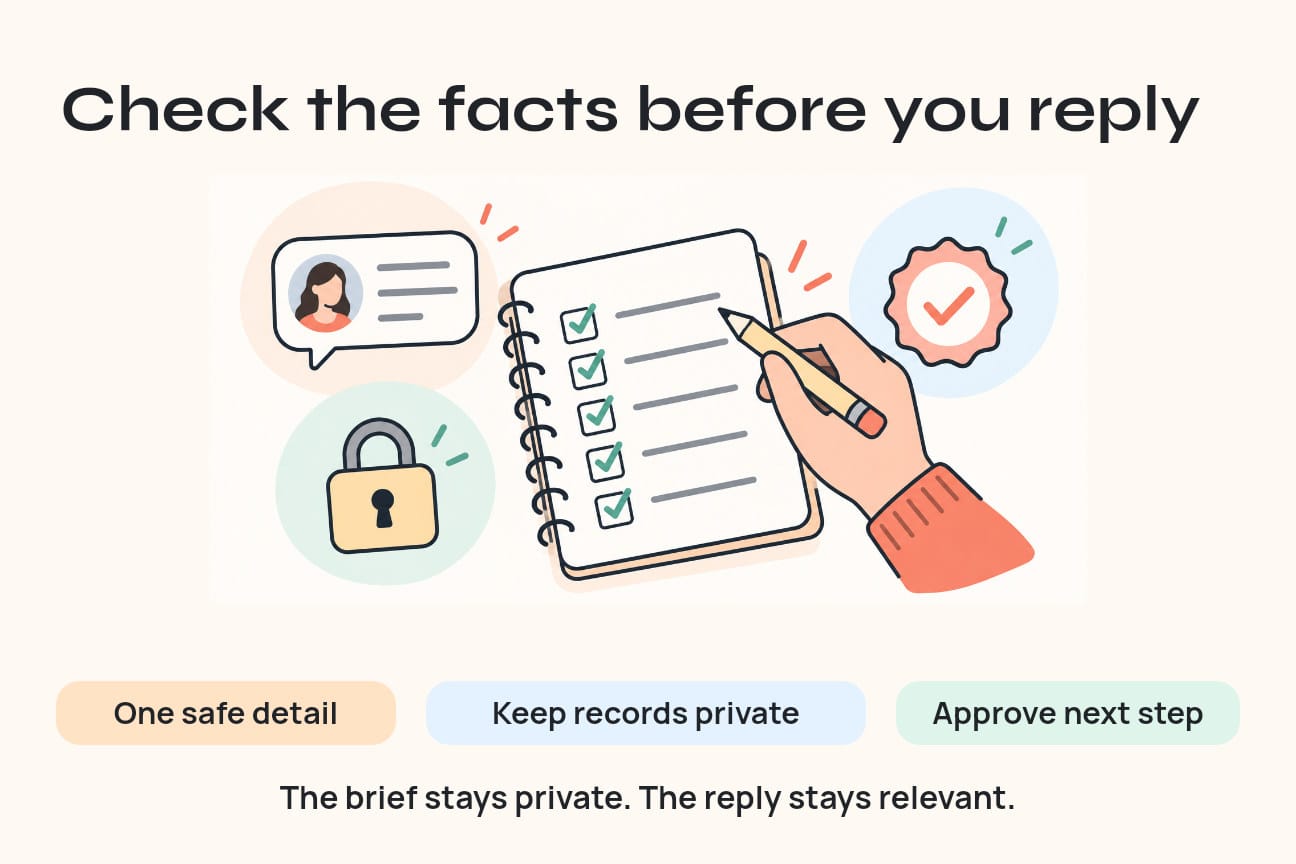
Consider a hypothetical electrician's review: “They explained the options clearly and left the area tidy.” The safe public detail is already in the review. There is no reason to mention the customer's street, invoice, payment method or the inside of their home.
A useful brief might say: acknowledge the clear explanation; thank them for mentioning the tidy work area; no further action needed. That produces a focused response without adding a sales pitch.
For a complaint about a missed appointment, the brief requires more work. Check whether the business has confirmed what happened. Record who can discuss the appointment privately. If the facts remain disputed, do not turn an assumption into “our technician arrived on time.”
Keep the brief proportionate. You do not need a lengthy case file for a straightforward thank-you. You do need approval before discussing a disputed job, money or an alleged service failure.
Write the response in three parts
Acknowledge the actual point
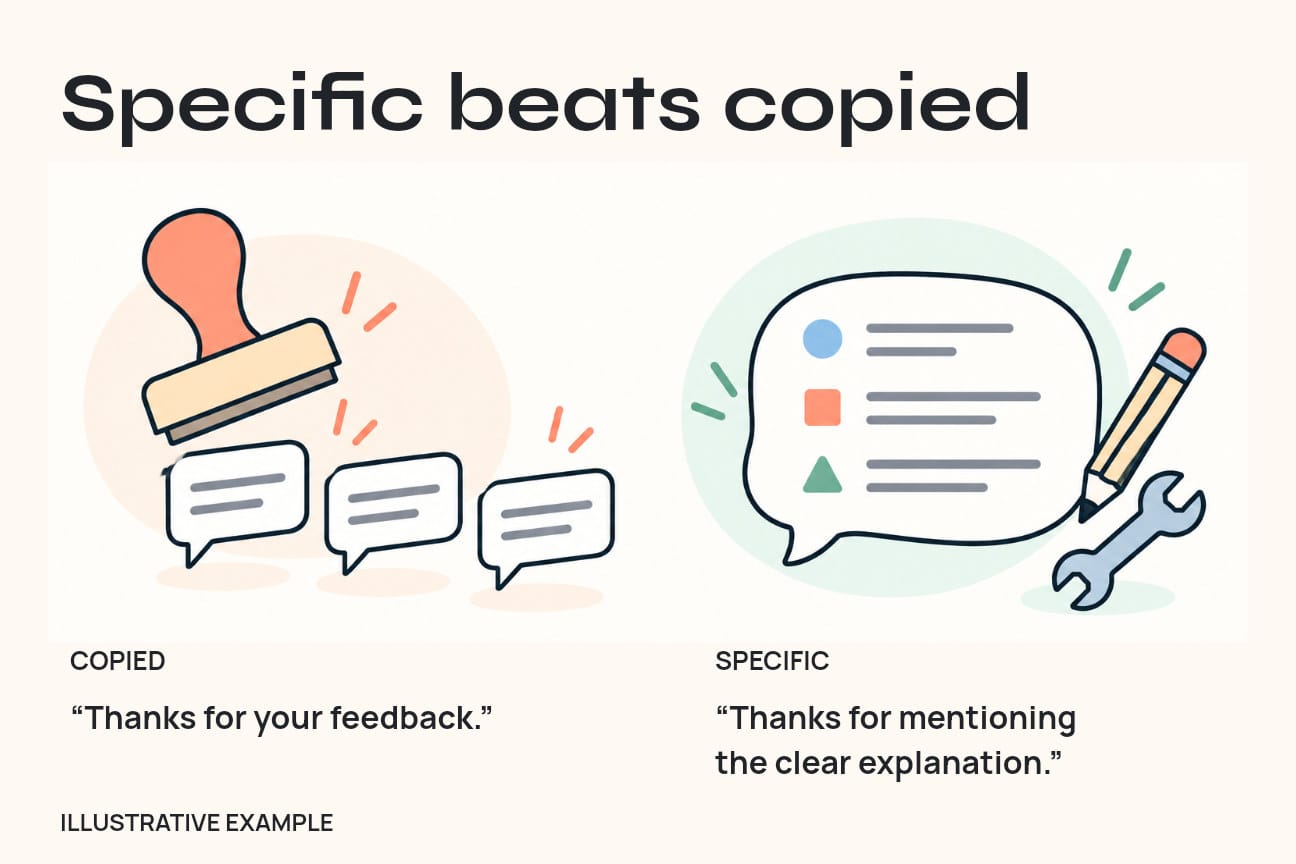
Name the aspect of the experience that matters. “Thanks for mentioning the clear explanation” is more useful than “Thank you for your valuable feedback.” For a complaint, recognise the concern without inventing a cause or outcome.
Add one checked detail
Choose a detail that supports the acknowledgement. Avoid inserting unrelated services, neighbourhood names or repeated search phrases. The response should read like a conversation about this review, not a miniature advertisement.
If you cannot verify an extra detail, leave it out. Specificity should come from evidence, not embellishment.
Offer a next step when one is needed
For an unresolved concern, explain how the customer can reach the right person through an official business channel. Do not ask them to publish their booking reference or phone number in another review comment.
Only promise an action the responsible person has approved. “We will refund this today” requires authority and a real plan. “Please contact our office so the service manager can check the appointment with you” is suitable only when that route and person actually exist.
Examples that sound like a local business
The following are hypothetical examples, not real customer reviews or client results. Each response assumes the business has checked the relevant facts and has the stated contact route.
A positive review with a useful detail
Customer: “The electrician explained our options and cleaned up before leaving.”
Possible reply: “Thanks for mentioning both the explanation and the clean-up. We're pleased those parts of the visit were helpful. We appreciate you taking the time to share your experience.”
The reply reflects what the customer said. It does not invent a technician's name, claim a perfect result or try to sell another service.
A mixed review with a service concern
Customer: “The repair was fine, but getting an arrival update was frustrating.”
Possible reply: “Thanks for letting us know about the arrival update. We're glad the repair met your needs, and we're sorry the communication was frustrating. Please contact our office through the number on our profile so our service manager can review the appointment with you.”
The reply acknowledges both parts of the experience. It does not claim the communication problem is already fixed. That claim belongs in a response only after the business has actually made and checked the change.
A negative review where the facts are still unclear
Customer: “Nobody turned up, and I wasted my afternoon.”
Possible reply: “We're sorry to hear you were left waiting. We need to check the appointment details before we can explain what happened. Please contact our office through the number on our profile and ask for the service manager so we can look into this with you.”
This offers a route to investigate without arguing publicly. An apology for the customer's experience does not require inventing an admission about facts the business has not established.
Do not label a review fake simply because you cannot match the display name to a customer record. People can use a different name online. A possible policy violation needs a separate assessment; it does not justify a hostile reply.
Use automation to prepare a draft, with approval before posting
A sensible automation workflow removes repetitive preparation while preserving business judgement. It can organise incoming reviews, attach the approved reply brief and prepare wording for a person to check.
This is a recommended operating design, not a claim that every business already has a working connection or that a particular tool can publish to every profile.
Start with a small pilot:
- Choose the intake route. Use the authorised profile interface or a supported connection. Decide who checks for new reviews if a notification fails.
- Provide an approved brief. Supply the customer's point, safe detail, permitted next step and privacy exclusions. Keep internal job records out of a public draft.
- Generate or write a short candidate. Ask for plain wording with no invented facts, promotions or promises. Compare it against the brief.
- Require an owner check. A person confirms relevance, tone, privacy and authority before posting. Escalate uncertain facts, payment disputes and serious complaints.
- Confirm the visible outcome. Record whether the response is awaiting approval, submitted or visible. A submitted response is not proof that it is publicly displayed.
Keep a manual fallback: the responsible person opens the profile, checks the review and writes the response from the same brief. If a connection breaks, hold automated actions and reconcile the actual review before trying again. Do not post a duplicate because a status message is missing.
Before expanding the process, review several drafted replies. Ask whether a customer could recognise their own experience in each response. If the wording fits every review equally well, improve the brief instead of adding more adjectives.
A public reply does not close a private service problem
Track the response and the customer case separately. A polite public acknowledgement may be complete while an appointment investigation is still open.
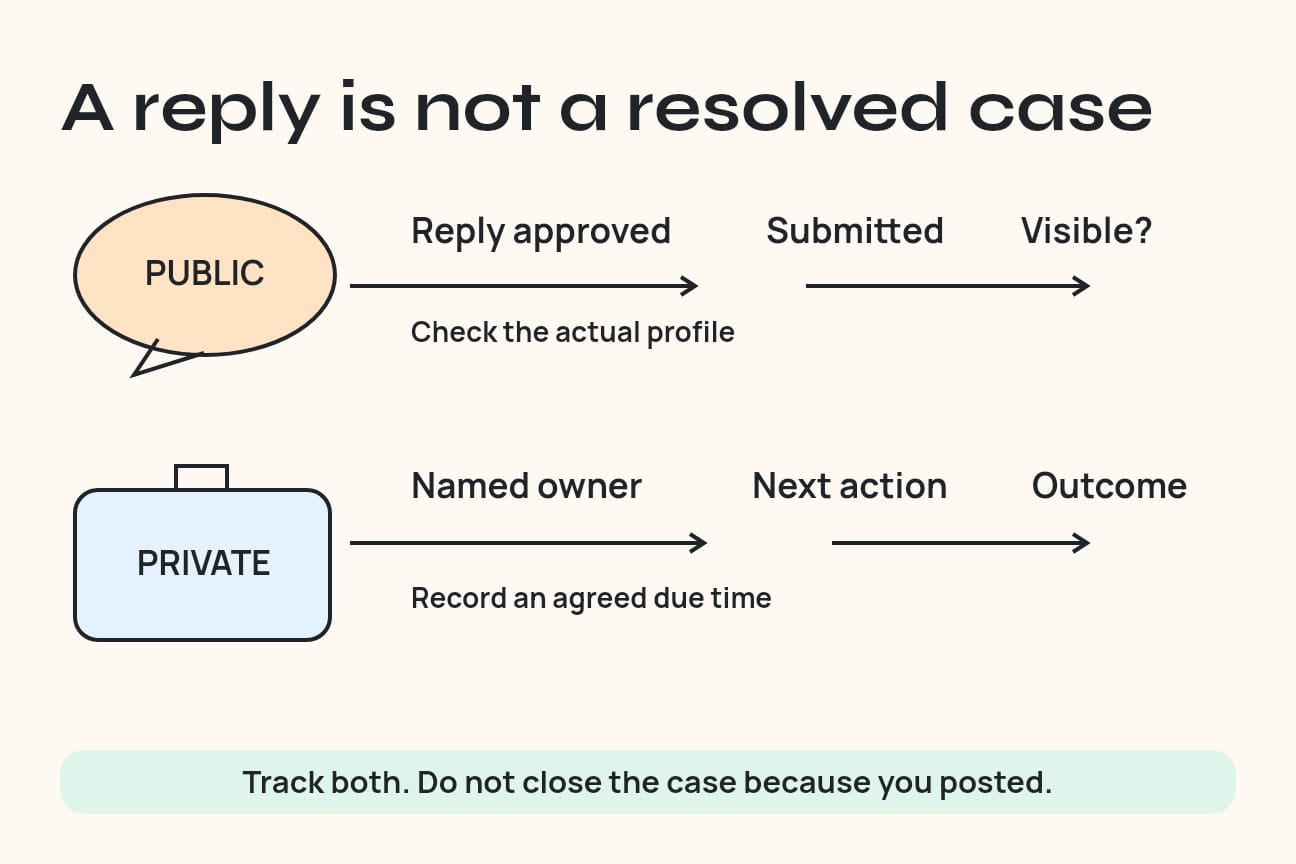
Use a short private register with a review reference, response status, case owner and next action. Record an agreed due time for unresolved work. If the customer never contacts the office, record that fact rather than marking the issue resolved.
For a weekly quality check, look at:
- Unanswered reviews: Which still need a decision or reply?
- Brief corrections: How often did the approver remove an invented detail or unsupported promise?
- Open concerns: Which customer cases still have an action due?
- Visible responses: Were submitted replies actually displayed?
These measures tell you whether the process is working. They do not prove that a reply caused a booking or changed your Maps position. If you track enquiries alongside them, keep that distinction in the report.
Frequently asked questions
How do I reply to a Google review?
For a verified business, open your Business Profile, select Read reviews and choose Reply beside the review. Enter the response and submit it. Google checks replies before displaying them. See Google's current review-management instructions.
Should every reply use the reviewer's name?
A displayed name can help a response feel personal, but it is not the only useful detail. Acknowledge the feedback itself. Do not reveal a private name from a customer record when the reviewer has not used it publicly.
Can I offer a discount to get a bad review changed?
No. Google's contribution policy prohibits incentives for posting, changing or removing reviews. Handle a legitimate service remedy on its own merits, without making it conditional on a review update.
Why is my reply not visible yet?
Google says approval usually takes up to 10 minutes, but can take up to 30 days in some cases. Check the current response status before reposting. The approval window is explained in the review-management instructions linked above.
How quickly should our business respond?
Choose an achievable review-checking routine and a backup owner. Google recommends timely replies, but its guidance does not set a universal 24-hour deadline. Speed helps only when the response is accurate and appropriate.
Make the next review easier to handle
Start with one reply brief and test it against three recent reviews: a specific compliment, a mixed experience and an unresolved concern. Check whether the resulting responses acknowledge the actual point, protect private information and offer only approved actions.
If reviews are being handled separately from the rest of your profile, JC Labs' Google Business Profile management brings review response support into the same routine as profile details, photos and ongoing activity. You can use the profile audit on that page to identify what needs attention first.
A useful reply tells the next customer how your business listens. A useful internal process helps you follow through on what you said.